Showing posts with label Al Taliaferro. Show all posts

Friday, April 29, 2016

Donald Duck - The Complete Sunday Comics 1939-1942

Donald Duck - The Complete Sunday Comics 1939-1942

I got this book a few weeks ago, but I still haven’t found the time to sit down with it. So this post will just be my first impression and some facts about the book.

The first volume collects all Sunday pages with Donald Duck from December 10, 1939 to December 27, 1942. So roughly 3 years of Sunday pages and a total of 160 pages of comics. In addition we get an intro article by Niels Houlberg Hansen.

Before Donald got his own series of Sunday pages, he appeared in the Sunday serial The Wise Little Hen (1934) and 67 Sunday pages in 1937-1938. They were all printed under the Silly Symphony logo and are not included in this book. Instead we can find them in the first and second volume of IDW's Silly Symphonies collection, where the first volume will be on sale next month. Donald also had some guest appearances in the Mickey Mouse Sunday comics, they can all be found it the two volumes of Mickey Mouse Color Sundays as part of Fantagraphics' Floyd Gottfredson collection.

Compared to the Donald Duck Daily Strip collection, this book has fewer pages and is more expensive. But all pages are colored using old file copies as a color guide – where the daily strip collection is in black and white. So I assume there’s a lot more work involved putting this book together, making it a bit more expensive. The Sunday collection is also a bit wider.


But both collections have the same height, so they look great together on the shelf.


My first impression of this book (and series) is really great! Everything from the source material used, paper, printing and binding are all good. And I think the size is perfect. By using the original colors as a color guide we get some weird looking colors now and then, like Gus Goose being all gray. But it’s also interesting to see how the original coloring was – so I don’t mind that. I’ve seen comments from people that prefer the daily strips and the Sunday pages to be printed together in the same book. Personally I think the books are better by separating the dailies and Sunday pages like IDW does.

A lot of the Sunday comics in this book have been published as 1-pagers in various Disney comics, but then some of the panels are usually cut. Sunday pages are also designed so they can be cut and printed in different layouts, so even if you’re a collector of newspaper clippings it’s hard to find complete copies. All pages in this book however are in the complete full format.

Here’s an example from two different Norwegian comics:


And the same page in the IDW book.


A few years ago they stared publishing the Donald Duck Sunday pages chronologically in the Swedish Kalle Anka Christmas album. I planned on collecting this series as I wanted to have the pages chronologically. But they were such a pain trying to get hold of. Now that IDW started a much better collection I don’t have to track down the Swedish comics anymore.

The IDW collection (top) vs. Kalle Anka Julbok (bottom)

Friday, April 15, 2016

Donald and his 10 nephews

In a comment on another post there was a question about a Taliaferro strip described as "In a 1940s Donald Duck newspaper strip, Donald applies for child benefit as the sole guardian of Huey, Dewey, and Louie". It turns out the strip in question was the August 21, 1944 Donald Duck daily strip.

So this post is by request, just showing the newspaper strip.

Donald Duck daily newspaper strip - August 21, 1944

The text in the strip say:

"How to do trick photography" (the book Donald is reading)
"U.S. Mail" (post box and bag)
"Bureau of Internal Revenue" and "Pay income tax here" (the door)
"With love, Donald Duck and dependents" (photography)
"Donald Duck Hollywood" + something I can’t read (envelope)

So, it sounds more like a matter of tax fraud. Donald doesn’t apply for child benefit in the strip.

This strip will be published in volume 3 of IDW’s Donald Duck daily strip collection, coming this summer. This is a series I highly recommend for anyone interested in Al Taliaferro’s work or early Disney comics history. Especially interesting in the last volume and the upcoming one is seeing how wartime in USA influenced the daily comic strips. And Donald is prepared for anything, getting a bomb shelter in his garden!

Pre-release cover for Donald Duck - The Complete Daily Newspaper Comics vol.3


Monday, January 18, 2016

Donald Duck: The Complete Daily Newspaper Comics volume 2

Donald Duck: The Complete Daily Newspaper Comics volume 2

I got the second volume of IDW’s Donald daily strip collection a few weeks ago. This book collects all daily strips from July 22, 1940 to January 2, 1943 plus the second part of David Gerstein’s essay about Al Taliaferro. I was a bit disappointed with the bonus material in the first volume, so I didn’t expect to see much of that in this book. But we got some rare publicity drawings and all Taliaferro illustrations from a 1948 children’s book. And I found the second part of the essay a lot more interesting than the first part, so no complains about the bonus material this time! If I have to nitpick something, it’s that the second part talks about several things we saw in the first volume (the license plate, Gus Goose, Bolivar…) so I think it would be better to say something about that in the first part. But it’s not a big deal.

The first volume had really good quality reprints of the strips, and from the credits it sounded like they had tracked down various sources to get the best possible quality. This volume also started with clean and good reprints, but a good deal of the 1942 strips seems to be from a less good source. Here are a few examples comparing the IDW collection (left) to the Norwegian strip collection (right).


From the August 4, 1942 strip

From the August 14, 1942 strip

Book 5 of the Norwegian collection


It might have been difficult to obtain better source material, but I hope they at least tried and not just went with the first complete run they could find. For a collection like this I’d rather wait a few extra months if it means getting better source material, or if restoration work needs to be done. There’s no need to rush these books out on the market.

I have to admit I didn’t read the second volume as thoroughly as the first one. I just went quick through it, so I don’t have that much to say about the strips (maybe there’s not that much to say either). But here are a few notes about some of the strips in volume two.

Hidden names


From the September 24, 1940 strip

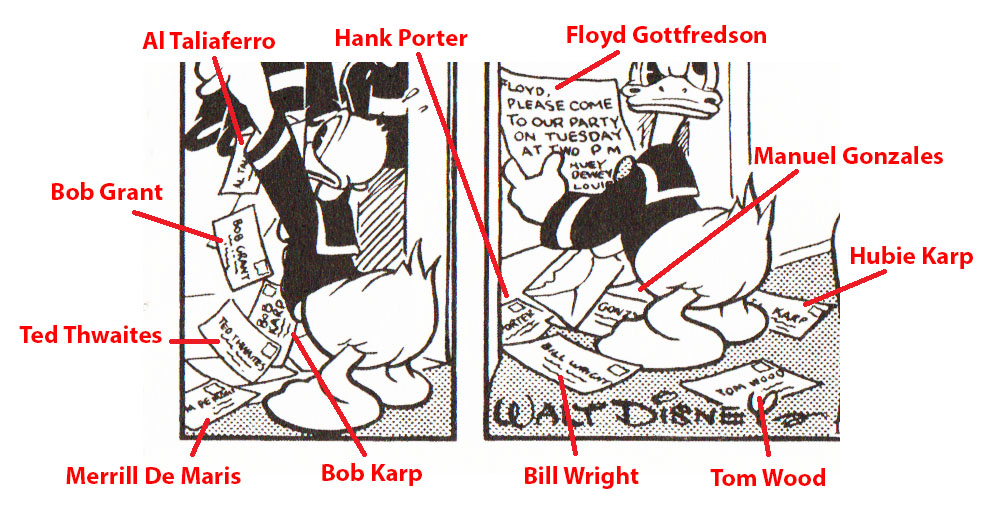
The names of a lot of people from the comic department are hidden in the September 24, 1940 strip. Here’s a list of them all (I think)


Daisy Duck
 

First comic appearance of Daisy Duck

The first comic appearance of Daisy Duck is in the November 4, 1940 strip. But we don’t see her name until a few days later (November 7) and her full name the next week (November 13). After that she becomes a regular character in the daily strips.


First time we see the name Daisy in the comics


First time we see the full name Daisy Duck in the comics

National Park poster


The May 19, 1941 strip

The May 19, 1941 strip was later used as a poster (probably) in National Parks. The images under is from an eBay auction, so I don’t know more about it than what you can see on the images. But the sign is changed from "Sequpia Park" (a national park in California) to "National Park", and at the bottom we have the text "U.S. Government Printing Office 1944". If anyone has more knowledge about this poster, please comment below!


National Park poster (image found on eBay)


Details from the poster (image found on eBay)

Wartime

There are a lot of wartime themed gags in this book, not that suprising as the strips are made during World War II. We also get notes with a plea for help inserted into the comic strips, as seen in the examples below.


The same logo/stamp is printed in a lot of 1942 strips. The first one say "You Help Someone You Know, When You Give to USO" and is for the United Service Organizations. The other one has the text "For Victory, Buy United States War Bounds and Stamps"

Tuesday, October 13, 2015

Donald Duck: The Complete Daily Newspaper Comics volume 1

Donald Duck: The Complete Daily Newspaper Comics volume 1

The first volume of Donald Duck: The Complete Daily Newspaper Comics came out last month. For the first time in English, the book is chronologically collecting the daily newspaper strips with Donald Duck. The first volume collects all strip from the beginning February 7, 1938 to July 20, 1940, roughly two and a half years with a total of 768 strips (if I counted right). The book is published by IDW as part of their Library of American Comics. I haven’t seen any info about this book being collected in future box sets like Fantagraphics like to do; instead it comes with a dust jacket.

Donald Duck: The Complete Daily Newspaper Comics volume 1

This is an important piece of Disney comic history, which I think should have been published in a collection like this a long time ago. But initially I was personally not too excited about this book, mainly because I already have all of the strips inside collected in Norwegian books. And also because there are so many other publications coming out these days. With monthly Disney comics from IDW, and three different series of hardcover books from Fantagraphics there’s a bit too much on the market right now. Another reason is that I tend to get bored fast when reading collections of gag strips, I prefer the longer adventure stories, and wasn’t too excited about re-reading the early Duck strips.

But I decided to give the first volume a try and pre-ordered it this summer. The pre-release cover art was slightly different at the time I ordered the book. Not that much was changed in the final layout, but I like new blue one better.


Pre-relese cover (brown-red) and final layout (blue)

While waiting for the book to arrive in the mail I managed to hype myself up so much that I did a cover-to-cover read the same day it arrived! (and a lot of it again while writing this blogpost) I did this by reading other Taliaferro comics and articles and re-watching the early Donald Duck animated shorts that I knew shared a lot of similar gags and ideas. But at the same time refraining from reading the strips collected in this book. So I went from a bit reluctant to really excited while waiting for the book.


All strips in this book are drawn by Al Taliaferro and the book starts with the first part of an essay about him. The introduction tells us that Taliaferro have never gotten the fame he deserved like other Duck artists, but then goes on saying that Al Taliaferro is one of an elite group known as the "Duck Men" (a bit contradicting isn’t it?) Later in the article we can read that the other three members of this group are Barks, Rosa and Jippes. Really? Who defined those four as the Duck Men? That labeling is really stupid if you ask me. Yes, Carl Barks is commonly referred to as "the duck man" and sure Rosa and Jippes have a large fan base. But so does van Horn and others. If someone had randomly said "duck men" to me, one of the first persons I’d think of is Jack Hannah (and yes, Taliaferro and Barks too). So far IDW has done a great job with its monthly titles, printing lots of Italian material. Especially by Romano Scarpa that I think should get more attention, and with that showing the American readers that great Duck comics is a lot more than Barks and Rosa. So why suddenly try to label Taliaferro, Barks, Rosa and Jippes as the elite "Duck Men"? The intention is probably to give Taliaferro more fame, but now you give the casual reader the impression that those four are the best of the best. And that is highly subjective.


Ok, the little rant is over.


When I started reading the comic strips I got the impression they were printed in a larger format than the Floyd Gottfredson Library does with the Mickey Mouse strips. But when comparing the two books I found out that’s not the case at all. They both print the strips in about the same size. While I think this size works perfectly for the Donald Duck strips, I wish the early Mickey-strips could have been printed a bit larger. They are often very detailed with a lot of dialog and action going on in every panel.


Compairing the Donald Duck newspaper archive with the Floyd Gottredson library and a 30's newspaper clipping

Im not sure if the strips have undergone any major restoration work (I don't think so) but the source material seems to be good. According to the credits, the source for some of them are the "Billy Ireland Cartoon Library & Museum", so it sounds like they try to track down the best possible source.


The early newspaper strips are made so they can be printed in both one or in two rows, where the first and second part of the strip are the same size. The Norwegian collection prints the strip over two rows, but I think it’s better to have the entire gag in one row like we have in the IDW book. Also, I think that's the most common way they were printed in the newspapers.

The first 3 books in the Norwegian collection, collecting the same strips as the first IDW volume.
Compairing the IDW Donald Duck newspaper archive to the Norwegian collection

As I said earlier, I recently watched a lot of the early Donald Duck animations. And I think this book is going to be a lot more interesting if you do that, because they are clearly used as an inspiration for a lot of the gags. Even if all strips are individual gags, there are some sequences that together make short storylines. I might have missed some, but here are the ones I wrote down while reading the book:

  • The Gus Goose visit from May 9 to May 24, 1938
    • Partly the same as Donald's Cousin Gus (1939)
  •  The camping trip from July 18 – July 30 1938
    • Spinoff/inspired by Good Scouts (1938)
  • Donald’s polar expedition from August 15 to August 27, 1938
    • Loosely based on Polar trappers (1938)
  • Donald and the ostrich from October 3 to October 15, 1938
    • Loosely based on Donald's Ostrich (1937)
  • The golf game from October 24 to November 5, 1938
    •  Spinoff/inspired by Donald's Golf Game (1938)
  • Donald visit Gus’s farm from November 9 to November 19, 1938, continued with 5 days of Donald back home with the goat.
  • Another camping trip from July 26 to August 5, 1939
  • Bobo the elephant from November 6 to November  11, 1939
    •  Seen in the Mickey Mouse newspaper strips and in Mickey’s Elephant (1936). Indented to be used in more animations that never made it to the screen. This story might be adapted/inspired by one of those drafts.
  • Pirate treasure adventure from April 29 to May 25, 1940

Mickey and Donald with Bobo the elephant
Mickey and Donald are both buying Bobo in the newspaper strips (he is named in both)

An interesting thing to note is that all these mini-stories start on a Monday and the majority of them go on for exactly two weeks. And a few exactly one or three weeks. So they were probably planned out to be a serial of a specific length from the beginning.

As with most series of gag strips; the jokes can start to be a bit repetitive after a while. But we don’t see much of that in the first years of the Donald dailies. We do have some with the same settings, like finding a place to sit at the cinema or driving in front of the train, but the jokes are still different. It gets a lot worse later, especially the strips in the 70’s. (I wonder how many Donald stranded on a deserted island jokes exists...that’s a LOT)


Donald Duck newspaper strips, in the cinema
Donald in the cinema. August 26, 1939, February 23, 1940 and April 15, 1940

Some examples of ideas from the animated shorts


The very first daily strip got the idea from Mickey's Circus (1936)


Lemonade, woodpecker and a hammock, inspired by Self Control (1938). We can see the woodpecker bugging Donald in a lot of other the strips in this book too.

From June 9, 1938 and the animated short "Self Control"

Donald’s polar expedition from August 15 to August 27, 1938 are based on Polar trappers (1938). We can see the same sign in the beginning.

From August 15, 1938 and the animated short "Polar trappers"

And Donald in a tuxedo disguise. A similar name was later used in the 1939 animation Donald’s Penguin where the penguin is called Tootsie.

From August 18, 1938 and the animated short "Polar trappers"

We first see a short serial with Hortense from October 3, 1938 to October 15, 1938, but he re-appears in several newspaper strips later. Under is Donald receiving a mysterious package in the newspaper strips and the 1937 animation Donald's Ostrich.


Gus Goose


From May 9, 1938 to May 24, 1938 we have a serial about Gus visiting Donald. The first two strips tell the same story as the start of the 1939 animation  Donald's Cousin Gus.

First we have Donald receiving a letter from Aunt Fanny.


Then *pooof* Gus gets right to the dinner table and starts eating.


The rest of the story is different in the daily strip and the animation. As the animated short came out a year later, the daily strip can’t be adapted from the finished version. Maybe it’s the other way, or maybe they both got the idea about Gus appearing on Donald’s door from an early script? It would be interesting to know the origin of that first part of the story. What we do know is that Gus was originally intended for another animation Interior Decorators, that was never finished. Some of the storyboards are printed in the Norwegian book Carl Barks – Tegnefilmene, part of a series of extra books for Egmont’s Carl Barks Collection.


Sketches for the unfinished animation "Interior Decorators"

The sequence where Gus appears on Donald’s doorstep does not seem to be a part of that story, but we do have a gag showing Gus' huge appetite. The August 1938 issue of Good Houskeeping also had an illustrated rhyming story with the same opening, but otherwise different story. It’s printed after the daily strip, but before the animation.


From Good Housekeeping #3808 (August 1938)

Donald’s car


Another interesting thing in this book is to follow the introduction 313, Donald’s now famous car.


It all started February 24, 1938 when he gets rid of his old car. Notice that the license plate on the old car says 113.


From February 24, 1938

The first time we get to see 313 is in the July 1, 1938 strip. The car does not have a license plate in this strip, and as the newspaper strips are in black and white, we don’t get to know the color in this first comic appearance. The car design and the later red coloring in the Dell comics are probably both from the 1937 animation Don Donald.

From July 1, 1938 and the colored 1941 print in Walt Disney's Comics and Stories #8

Don Donald
The poor burro can't believe Donald traded him for a car

We usually see the whole car in this same gray shading, but one time the fenders were colored all black. This looks more like the Italian way to color the car where the fenders are blue.

From the August 9, 1938 strip and an Italian story

It takes a while until we actually see the 313 license number, but for a while we see the car with blank license plates. The first time we see the car with a back license plate is in the September 19, 1938 strip, and we don’t see the front plate until a year later (October 25, 1939) 


From September 19, 1938 and October 25, 1939

 A couple of times we also see Donald using another car

From May 20, 1939 and June 19, 1939


Then on March 22, 1940 we finally see the 313 number. This is the first time we see this number as far as I know, so the number is probably invented by Bob Karp or Al Taliaferro.

From March 22, 1940

The next time we see Donald use another car after this, there’s a hidden number joke. Look closely at the license numbers in the June 29, 1940 strip.

From June 29, 1940

When Western started making Disney comics they continued using the same car, and the good ol’ 313 is now synonym with Donald’s car.


Carl Barks first used the car in Good Neighbors (1943) and later we got to know what model and parts it’s composed of in Volcano Valley (1947)


Carl Barks using the car in "Good Neighbors" and "Volcano Valley"

Other notable moments in the book


The Silly Symphony Sunday pages started the whole Donald Duck universe and Mickey Mouse universe thing. Earlier they had been appearing together in the Mickey Mouse newspaper comics. But to not have the same characters in two different Sunday series at the same time, Donald stopped appearing in Mickey stories when he got his own Silly Symphony series in 1936. This continued in the Donald Duck daily strips making the Mickey and Donald comics appear as two different universes. But one little slip-up seems to have been made. The February 28, 1938 strip features Clarabelle, an at the time regular character in the Mickey-strips.


From February 28, 1938

The first ever comic appearance of Bolivar is in the March 17, 1938 strip. Earlier we’ve seen him in the animation Alpine Climbers (1936)

From March 17, 1938

We get to know that Donald won the pie-eating contest in 1930. But did you know he won it again in 1948?


From November 5, 1938 and August 9, 1948

In the March 15, 1939 strip Donald is trying to guess how Dewey spell "cat". In the original dialogue Donald is guessing the correct Norwegian word for cat (K-A-T-T). While in the Norwegian translation he say "C-A-T" (alright, this is probably not that funny if you’re not Norwegian )

From March 15, 1939

Future books


About the same time as vol.1 of the "Donald Duck: The Complete Daily Newspaper Comics" was released, vol.2 and another book were announced. The new series will be called "Donald Duck: The Complete Sunday Comics" starting with Donald’s Sunday pages from 1939-1942. Bruce Canwell said in an earlier interview that they planned on doing a Silly Symphonies series, so I half-expected that to come first. But I’m not surprised they decided to do the Donald Duck Sundays first to see how they sell. I hope they still plan on doing the
Silly Symphonies collections though; personally I’m a lot more excited for those! I really want to see Elmer Elephant and some of the other rare series collected!

The release dates can still be changed, but Amazon list January 14, 2016 for vol 2 of the daily strips and March 3, 2016 for the Sunday pages.


Pre-release covers of future books

To summarize; I had a lot of fun with volume 1 of this series, even if it’s just a collection of simple gag stories! Maybe one of the reasons was that the book didn’t have any articles with background info or trivia like we are spoiled with in the Floyd Gottfredson books. So I had to do all that research myself. But I’m so lucky I have a large collection of comics and articles to dig into. For a more casual reader of the book, I see a lot of wasted potential for interesting background articles! F.ex. about Gus Goose, comparison to the animated shorts, or about 313 as I wrote about in this blog. But an article about Bobo the elephant, similar to the one in the Floyd Gottfredson library vol.3 would have been nice too. Or just a simple gallery with covers inspired by the strips in this book. I’m definitively going to get the next volume too, but I hope we get to see more bonus material in future books.

No need to comment on this :)